 Robine Studio
Plate Reverb
Delay & reverb · Circuit · Bronze
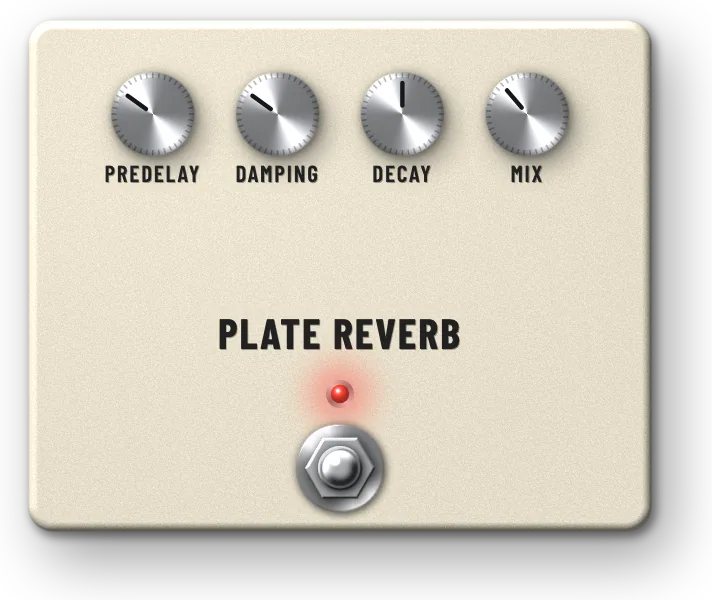
The real engine of the app, compiled for the browser, plays a recorded guitar (DI) through this pedal, then a clean amplifier and its cabinet. Turn the knobs (drag, scroll or use the arrow keys) and press the footswitch to hear it on and off. DI phrases by TONE3000, for now.
A network of delays feeding back into each other, in the manner of a plate.
The bright, smooth halo of a studio record. Play a chord and it blooms at once, with no echo you could count: a dense shimmer that wraps the notes, follows them and fades away, brighter than any room. Keep it short and a clean rhythm part glows; open Decay and a slow melody or a solo floats on its own tail for seconds. Predelay lets the pick through before the plate answers, so the playing stays in front.
Its story
A plate was the studio’s answer to the echo chamber. In 1957 the German firm EMT (Elektromesstechnik), working with a broadcasting institute, brought out the EMT 140: a very thin steel sheet, one metre by two, hung by its corners in a frame. A driver like a loudspeaker’s sets it vibrating, pickups on the sheet read what it does, and a felt damper, moved closer to it or further away, sets the reverberation from one to five seconds. The whole thing weighed about 270 kg (600 lb) and needed a room of its own, away from the noise. What it gave back came almost at once, and dense from the very start.
Abbey Road had four of them from the late 1950s, seven by 1976. They are on the Beatles’ Sgt. Pepper’s Lonely Hearts Club Band and on Pink Floyd’s The Piper at the Gates of Dawn and The Dark Side of the Moon; John Lennon liked its sound so much that he bought a stereo one for Imagine. The 140 stayed in production for 25 years, and it is still taken as the plate of reference.
Then reverberation became digital: the EMT 250, the first commercial digital reverb, in 1976, and Lexicon’s 224, shown in 1978, whose plate programmes are all over the drums of the 1980s. How a reverberator is made out of delays and filters is told on the Room Reverb’s page, from Schroeder in 1962 on. In 1997 Jon Dattorro published one of the “plate class” in the Journal of the Audio Engineering Society: a few diffusers, then a ring of delays feeding back into itself, the two allpasses of its ring slowly modulated so that a long tail does not ring. It has become a famous design, the starting point of software reverbs since.
The variant you play
There is no pedal behind it, and no steel: it is Dattorro’s reverberator written as a netlist for Robine Studio, with his delay lengths, his coefficients and the seven output taps of his left channel. In order:
- Predelay, from 1 to 100 ms, before anything else;
- a low-pass at 10 kHz on the way in, then his four input diffusers, allpasses that turn a pick attack into a cloud of small echoes;
- his ring: four quarters, each an allpass and a delay line, 725 ms around. The figure of eight he draws is that ring, drawn here as the single loop it is. Two quarters go through a low-pass, the Damping: about 16 kHz with it at 0, about 1.5 kHz at 1. All four go through the Decay attenuator, up to 0.98 per quarter;
- the seven taps he reads the tail from, mixed back with the dry sound by Mix, from the dry sound alone to the plate alone.
Three things differ from his drawing: nothing is modulated, the input enters the ring at one point instead of two, and it is mono. The Room Reverb uses the same ring at 0.18 of its size; the Ambient Reverb is this one with its modulation back and room for very long tails.
What it is not:
- a plate: a plate is a vibrating sheet of steel. This is the recipe of a reverberator that sounds like one, not a model of the EMT 140 or of any plate;
- a circuit one could build: a reverb’s heart is not an electronic part, and the delay lines are ideal ones;
- stereo or moving: it is mono, and since nothing is modulated, a very long tail can ring a little at the ring’s own frequencies.
To start
- A glow on a clean rhythm part: Decay at 0.3 (a tail of about a second), Damping around the middle, Mix low, around 0.2.
- A ballad or a slow solo: Decay between 0.5 and 0.7 (1.7 to 3.2 s), Predelay up to about 0.6 (some 16 ms) so the attack of each note stands out before the plate answers.
- A wash: Decay at 0.9 (about 9 s), Damping toward 1 so the tail turns dark as it lasts, Mix up to taste.
The circuit
One line per part: its name, the nodes it connects, its value (1.6e3
is 1.6 kΩ, 1e-8 is 10 nF). An A line is a delay line, its time in
seconds (delay=), or between min and max set by a knob; an E
line is an ideal amplifier, the last number its gain; a P line is a
potentiometer: its top end, its wiper, its bottom end. gang=Decay ties
the four Decay attenuators to the one knob, as gang=Damping does for
its two low-passes.
Robine plate reverb
* Written for robine-spice, after J. Dattorro, "Effect Design, Part 1: Reverberator
* and Other Filters" (JAES, 1997): four allpass diffusers, then a ring of four
* allpasses and four delay lines, with his lengths, his coefficients and the
* seven output taps of his left channel. It is his figure-of-eight tank drawn
* as the single loop it is. Differences: nothing is modulated, the input enters
* the ring at one point instead of two, and it is mono.
* A plate is a mechanical object; nothing here is a circuit one could build. It
* is in the library because a reverberator is delay lines and filters wired in
* a loop, which the delay element makes expressible, and as a usable effect.
* Controls: Predelay (1 to 100 ms), Damping (0 bright, 1 dark), Decay, Mix.
* Decay and Damping each move several potentiometers at once (gang=).
Vin in 0 DC 0
Rin in 0 1e6
Ebuffer dry 0 in 0 1
APredelay early 0 dry 0 min=1m max=100m pos=0.3
* Input bandwidth, 10 kHz.
Rband early band 1.6e3
Cband band 0 1e-8
Eband x0 0 band 0 1

* Input diffusion.
Ein1a in1.t 0 x0 0 1
Ein1b in1.v in1.t in1.d 0 -0.75
Ain1 in1.d 0 in1.v 0 delay=4.771345e-03
Ein1c in1.u 0 in1.d 0 1
Ein1d in1 in1.u in1.v 0 0.75
Ein2a in2.t 0 in1 0 1
Ein2b in2.v in2.t in2.d 0 -0.75
Ain2 in2.d 0 in2.v 0 delay=3.595309e-03
Ein2c in2.u 0 in2.d 0 1
Ein2d in2 in2.u in2.v 0 0.75
Ein3a in3.t 0 in2 0 1
Ein3b in3.v in3.t in3.d 0 -0.625
Ain3 in3.d 0 in3.v 0 delay=1.273479e-02
Ein3c in3.u 0 in3.d 0 1
Ein3d in3 in3.u in3.v 0 0.625
Ein4a in4.t 0 in3 0 1
Ein4b in4.v in4.t in4.d 0 -0.625
Ain4 in4.d 0 in4.v 0 delay=9.307483e-03
Ein4c in4.u 0 in4.d 0 1
Ein4d in4 in4.u in4.v 0 0.625

* The ring: what comes back from its end is added to the diffused input.
* Each quarter is an allpass, a delay line, a low-pass on two of them, and
* the Decay attenuator (0.98 at most).
Ering1 ring.t 0 in4 0 1
Ering2 ring ring.t return 0 1
Etank1a tank1.t 0 ring 0 1
Etank1b tank1.v tank1.t tank1.d 0 -0.7
Atank1 tank1.d 0 tank1.v 0 delay=2.257989e-02
Etank1c tank1.u 0 tank1.d 0 1
Etank1d tank1 tank1.u tank1.v 0 0.7
Aline1 line1 0 tank1 0 delay=1.496253e-01
Rdamp1 line1 damp1.a 1e3
PDamping1 damp1.b damp1.b damp1.a 1e4 taper=lin pos=0.3 gang=Damping
Cdamp1 damp1.b 0 1e-8
Edamp1 damped1 0 damp1.b 0 1
PDecay1 damped1 decay1 0 1e5 taper=lin pos=0.5 gang=Decay
Edecay1 q1 0 decay1 0 0.98
Etank2a tank2.t 0 q1 0 1
Etank2b tank2.v tank2.t tank2.d 0 -0.5
Atank2 tank2.d 0 tank2.v 0 delay=6.048184e-02
Etank2c tank2.u 0 tank2.d 0 1
Etank2d tank2 tank2.u tank2.v 0 0.5
Aline2 line2 0 tank2 0 delay=1.249958e-01
PDecay2 line2 decay2 0 1e5 taper=lin pos=0.5 gang=Decay
Edecay2 q2 0 decay2 0 0.98
Etank3a tank3.t 0 q2 0 1
Etank3b tank3.v tank3.t tank3.d 0 -0.7
Atank3 tank3.d 0 tank3.v 0 delay=3.050973e-02
Etank3c tank3.u 0 tank3.d 0 1
Etank3d tank3 tank3.u tank3.v 0 0.7
Aline3 line3 0 tank3 0 delay=1.416955e-01
Rdamp3 line3 damp3.a 1e3
PDamping3 damp3.b damp3.b damp3.a 1e4 taper=lin pos=0.3 gang=Damping
Cdamp3 damp3.b 0 1e-8
Edamp3 damped3 0 damp3.b 0 1
PDecay3 damped3 decay3 0 1e5 taper=lin pos=0.5 gang=Decay
Edecay3 q3 0 decay3 0 0.98
Etank4a tank4.t 0 q3 0 1
Etank4b tank4.v tank4.t tank4.d 0 -0.5
Atank4 tank4.d 0 tank4.v 0 delay=8.924431e-02
Etank4c tank4.u 0 tank4.d 0 1
Etank4d tank4 tank4.u tank4.v 0 0.5
Aline4 line4 0 tank4 0 delay=1.062800e-01
PDecay4 line4 decay4 0 1e5 taper=lin pos=0.5 gang=Decay
Edecay4 return 0 decay4 0 0.98

* Wet signal: seven taps, each a short delay line fed like the long one it
* taps (a line's input, or the inside of an allpass).
Atap1 tap1 0 tank3 0 delay=8.937872e-03
Ewet1 wet1 0 tap1 0 0.6
Atap2 tap2 0 tank3 0 delay=9.992944e-02
Ewet2 wet2 wet1 tap2 0 0.6
Atap3 tap3 0 tank4.v 0 delay=6.427875e-02
Ewet3 wet3 wet2 tap3 0 -0.6
Atap4 tap4 0 tank4 0 delay=6.706764e-02
Ewet4 wet4 wet3 tap4 0 0.6
Atap5 tap5 0 tank1 0 delay=6.686603e-02
Ewet5 wet5 wet4 tap5 0 -0.6
Atap6 tap6 0 tank2.v 0 delay=6.283391e-03
Ewet6 wet6 wet5 tap6 0 -0.6
Atap7 tap7 0 tank2 0 delay=3.581869e-02
Ewet7 wet7 wet6 tap7 0 -0.6
PMix wet7 out dry 5e4 taper=lin pos=0.35
Rload out 0 1e6
.input Vin
.output out
Measured against
No real reverb: there is no plate it claims to be, and a capture (NAM) cannot hold a reverb’s tail. It is measured against ngspice, the reference simulator, which is given each delay line as a matched transmission line between two buffers, and on its own impulse response, at the netlist’s Damping (0.3):
| Decay | Reverberation time (T60) |
|---|---|
| 0.3 | 1.1 s |
| 0.5 | 1.7 s |
| 0.7 | 3.2 s |
| 0.9 | about 9 s |
Its grade
Bronze, score 100. The maths is right: it follows ngspice at −152.2 dB at 48 kHz and −151.9 dB at 192 kHz, and its four knobs agree with it. It is held at bronze because nothing real has been compared with it (the grade says: 0 of 1 settings close to a real device), and nothing can be, since it is no copy of a plate.
Sources: Reverb effect (Wikipedia), Elektromesstechnik (Wikipedia), The Origins of EMT Reverb (Universal Audio), Lexicon (Wikipedia), UA Lexicon 224 (Sound On Sound), reverberator (MathWorks), Plateau (Valley Audio); J. Dattorro, “Effect Design, Part 1: Reverberator and Other Filters”, JAES 45(9), 1997.