 Robine Studio
The models
Where the pedals of the rig come from, their circuit simulated part by part and measured against the real ones, and the story of each.
Circuits, not imitations
A pedal in Robine Studio is not an effect trying to sound like the original: it is its circuit. Every resistor, capacitor, transistor and diode of the schematic is there, and the app works out, sample by sample, what the current does through them.
That changes how it plays. When you turn a knob, the same potentiometer moves in the circuit. When you roll back your guitar’s volume, the pedal cleans up like the real one, because its transistors see less signal. When you dig in, it saturates more, and in its own way.
Checked against real pedals
A circuit copied from a schematic can hide a mistake: a value misread, a wire in the wrong place. So every model goes on the bench. The same signals go through the model and through captures of real pedals (Neural Amp Modeler), set at several positions of their knobs, and we measure what differs: the frequency response, the way the pedal compresses, its harmonics, and what the ear hears on a real guitar take.
Each model gets a medal, from tin to platinum. It does not say whether the pedal sounds good, but how far it has been proved to be the real one:
| Medal | What it says |
|---|---|
| Tin | The model runs, but its score is under 40: far from the reference simulator (ngspice), or far from the real pedals at the settings compared. |
| Bronze | The maths is right: it gives what ngspice gives. Nothing yet says it is the pedal. |
| Silver | Close to a real pedal at one setting. |
| Gold | Close at three different settings. |
| Platinum | Close at five different settings or more. |
A setting counts only when it is close on its own: an error (pre-emphasised ESR) of −10 dB or better, and a PEAQ grade of −2 or better. Nor can the medal go past what the 0 to 100 score of all the measurements gives: bronze from 40, silver 60, gold 80, platinum 92. What comes from TONE3000 is a capture, not a circuit: no medal, but the TONE3000 mark.
And where a model still differs from the pedal, we say so, with what we know about it. A grade only goes up with a new measurement, never by nudging a value until the curves meet.
What you will find for each pedal
- Its story: where it comes from, who played it, why people still look for it.
- The variant chosen: a famous pedal has often had ten versions. We tell you which one is under your foot, and why that one.
- Its circuit, as the app computes it.
- The captures it was measured against, at which settings, and what they showed.
- Its grade, and what is left to prove.
Every model of the app’s library has its own page. Below, they are under their category, in the order the library shows them, with what each is made of, a circuit’s grade and the first sentence of what the library says of it. Those not written up in full yet have a short page: the same facts and the library’s whole description.
Compression
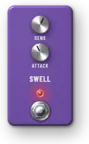
Boost
-
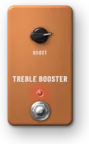 Treble Booster Circuit · Bronze A germanium transistor and a small input capacitor: it lets the treble in and pushes the amplifier with it.
-
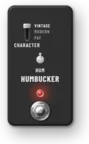 Humbucker Built-in processing A single-coil guitar heard as a humbucker: its resonance moved down, the string heard from two points as two coils hear it, and more level.
-
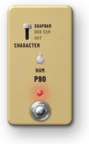 P90 Built-in processing A single-coil guitar heard as a P-90: a wider, stronger pickup, resonating lower and with more level.
Overdrive & distortion
-
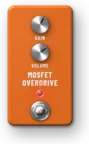 MOSFET Overdrive Circuit · Bronze A MOSFET booster into two MOSFETs that clip softly, each through the other's body diode.
-
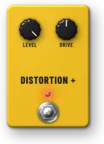 Distortion + Circuit · Bronze An op-amp into a pair of germanium diodes to ground: the circuit this library started with.
-
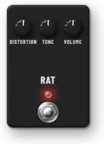 Rat Circuit · Tin An op-amp driven hard into silicon diodes, with a filter that takes treble away as it is turned up.
-
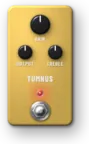 Tumnus Circuit · Silver Wampler's mini Klon: the Centaur's circuit, germanium diodes after an op-amp, with part of the clean signal kept under the drive.
Fuzz
-
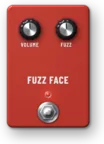 Fuzz Face Circuit · Bronze Two transistors and very little else.
-
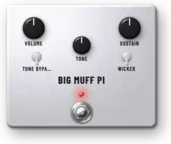 Big Muff Pi Circuit · Bronze Four transistor stages, two of them clipping, around a tone control that scoops the middle.
Modulation
-
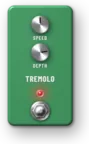 Tremolo Circuit · Bronze A JFET opened and closed by an oscillator.
-
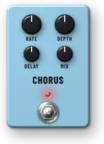 Chorus Circuit · Not graded A short delay whose time an oscillator sweeps, mixed with the dry signal.
Pitch
-
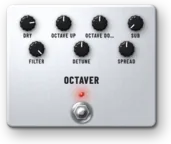 Octaver Built-in processing The signal again an octave up and one or two below, played as a chord and not note by note.
-
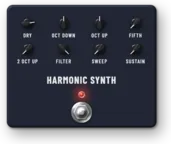 Harmonic Synth Built-in processing Four harmonies of what you play (an octave down, an octave up, a fifth and two octaves up), mixed as a chord and run through a filter that sweeps by itself.
Delay & reverb
-
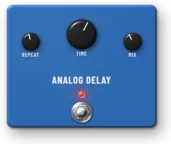 Analog Delay Circuit · Bronze Repeats that get darker each time round, and saturate instead of growing when pushed past unity.
-
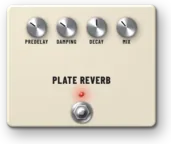 Plate Reverb Circuit · Bronze A network of delays feeding back into each other, in the manner of a plate.
-
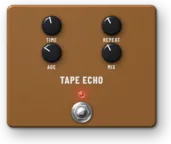 Tape Echo Circuit · Not graded Repeats that are recorded, saturated and played back darker each time round, on a tape that wobbles.
-
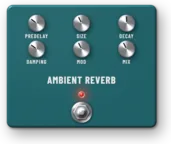 Ambient Reverb Circuit · Not graded A plate reverb made for long tails: up to a quarter of a second of predelay, a Size from closet to cathedral, a tail that can run for tens of seconds and two slow oscillators so that it does not ring.
-
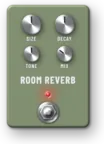 Room Reverb Circuit · Bronze A small room, to be there rather than heard: eight reflections off its walls in its first few tens of milliseconds, then a short tail, from a third of a second to most of one with Decay.
Looper
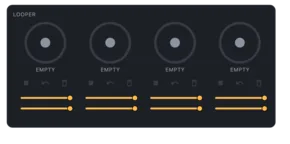
Amplifiers
-
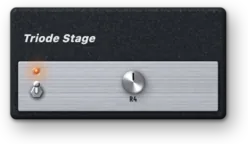 Triode Stage Circuit · Bronze One 12AX7 triode: the building block of every valve preamplifier, on its own.
-
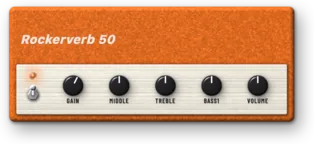 Rockerverb 50 Circuit · Tin The preamplifier of a modern British high-gain head: four triode stages and a tone stack.
-
 5E3 Deluxe Circuit · Tin A whole tweed combo, preamplifier, phase inverter, two 6V6 and its output transformer.
-
 JCM800 Combo Circuit · Bronze The 2203 preamplifier, modified for more gain, as a 2x12 combo.
-
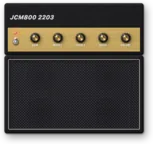 JCM800 2203 Circuit · Bronze The preamplifier of the 100 watt head that defined the sound of the 1980s.
-
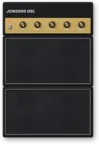 JCM2000 DSL Circuit · Bronze The preamplifier of its successor, with more stages and more gain.
-
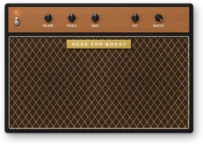 AC30 Top Boost Circuit · Bronze A whole British combo, the Top Boost channel: its treble and bass stack, a tone cut between the phases, four EL84 with no feedback, and its output transformer.
-
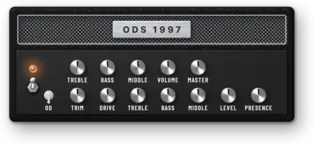 ODS 1997 Circuit · Bronze An Overdrive Special as traced from a 1997 amp: a clean channel, an overdrive of two more stages with its own tone stack, two EL34 with feedback.
Cabinets
-
 Greenback Open Back Impulse response For the AC30: its Greenbacks (G12M-25), as they sound in an open back.
-
 Mesa 2x12 V30 Impulse response A closed Mesa 2x12 with Celestion Vintage 30s, through an MD421: the balanced mix of its microphone positions.
-
 Mesa 2x12 V30 Cone Impulse response The same Mesa 2x12, the MD421 an inch from the cone: the warmest of its positions, with the least above 5 kHz.
-
 1960AX Greenback Impulse response A Marshall 1960AX of 1998 with Celestion Greenbacks (G12M-25), an SM57 on the upper speaker: the presence at 4 kHz of the classic British stack, for the JCM800s.
-
 1960AX Greenback e606 Impulse response The same 1960AX, an e606 on a lower speaker: more body below, a softer 2 kHz, and about 4 dB louder.
-
 V30 4x12 Impulse response A closed 4x12 with Celestion Vintage 30s, through an SM57: an impulse response.
-
 V30 4x12 Bright Impulse response The same Vintage 30s through another SM57 take, with more presence: for an amplifier that is dark already, such as the JCM800 Combo.
-
 G12F 4x12 Impulse response A Celestion Rockdriver Junior (G12F-60) in the same 4x12, through an SM57: fuller lows and the least fizz above 6 kHz, for the brightest amplifier, the JCM2000 DSL.